Last Saturday was our first CSA Share delivery where we delivered to all of our customers. Preparing each 10lb share turned out to be a little more work than we had calculated. We tried to make sure that every share included both beef and pork as well as a variety of cuts. At first we second guessed our decision to limit CSA Shares. However, now we are glad that we did. Like everything else we have experienced, the first few tries require us to overcome a learning curve. Once we get into a good groove with our CSA Shares, we will reevaluate our ability to handle more CSA Shares.
Last Saturday was also our first chicken delivery. Aside from the chickens being a little smaller than we expected, we are very happy with the quality and flavor that our chicken offers. We have already had several emails from our customers who are thrilled with the superior meat quality and flavor. The chickens we delivered on Saturday were the New Hampshire Reds (Red Ranger). We found that the chickens that reached a 4lb dressed weight had considerably more breast meat than the 3-3.5lb chickens. Our next batch of New Hampshire Reds will be raised two weeks longer in order to get all of them into this 4 lb. range. We plan to have these ready the first weekend of August. In the meantime, our next group of chickens will be the Delaware and Plymouth Rock chickens. We expect that these chickens will be true to the heritage breeds with more slender dispositions and an abundance of flavor. We will harvest these chickens in June. For July we plan to harvest another type of chicken. This chicken will be the Slow Cornish Cross. These chickens have the heavy muscling and large breasts that many are used to. The difference is that they grow much slower allowing their skeletal system and organs to keep up with their growth rate. As a precaution, we are also feeding them a lower protein feed to ensure that they stay healthy and happy. This is simply an experiment, but so far we haven’t lost a single Slow Cornish Cross chicken which leaves us very optimistic.
Turkeys have been a bit more challenging than the chickens. Again, we blame ourselves for simply lacking the experience required to raise poultry on pasture on this level of production. However, how else can we learn unless we try? This past Friday we moved our 80 young turkeys from the brooder to the pasture. The forecast called for a little rain but in Vernon it decided to snow. Sadly, we found 17 turkeys that didn’t make it through the night. Had we known it would get cold enough to snow, we never would have moved them from the brooder. Interestingly, all but two of the 17 were Bourbon Reds. The Royal Palms seem to be much more hardy and cold tolerant. This is good for us to know as Vernon is rather cold. In fact, we run the furnace in our home from September to the first of June. This only leaves about three months of warm weather. Even during these three months, we have day/night temperature differences of 40-50 degrees. This kind of weather can be hard on certain breeds of animals which is partly why this year has been so challenging. Since, nobody in Vernon or Utah for that matter, has raised large numbers of heritage poultry, we really have no record to reference. We are learning as we go. We have helped several other small farms who are getting started in Utah by sharing our experiences so that they might avoid some of the problems we have incurred. We are learning (the hard way) which breeds are better suited for our climate. We are confident that by next year we will have a much better success rate.
As mentioned above, we have already heard back from several customers that the chicken is fantastic. However, if anybody else has had a chance to try the chicken, we would love to hear your feedback. What do you think of our idea to raise Slow Cornish Cross? Do you like the idea of more breast meat or oppose the use of non heritage breeds? Remember we we want to be your farmer. This means we need to know what kind of food you want. We look forward to hearing your ideas!

Showing posts with label chicken. Show all posts
Showing posts with label chicken. Show all posts
Wednesday, May 26, 2010


Wednesday, April 7, 2010
Chickens on Pasture
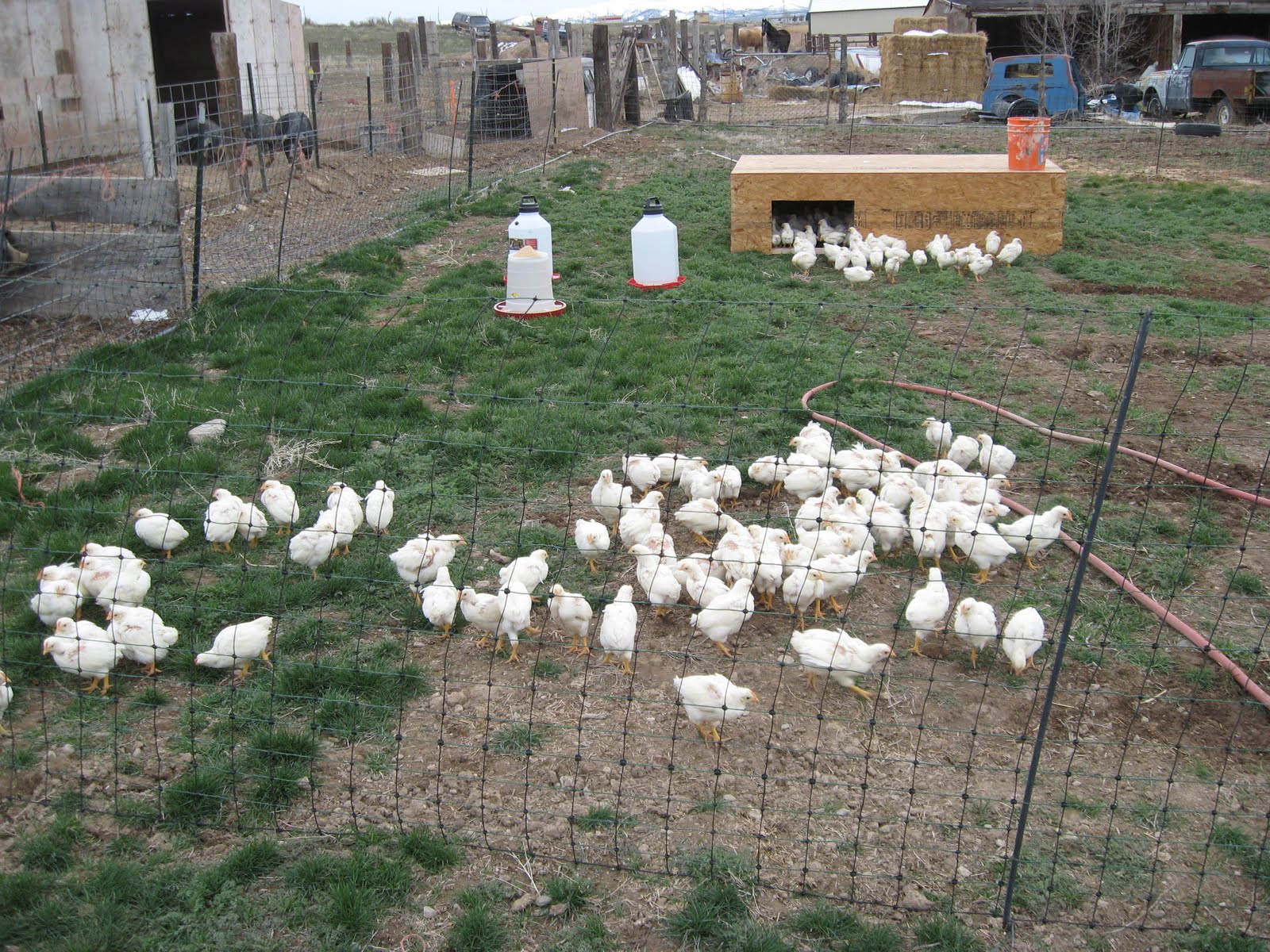
We finally got the chickens out on pasture, which turned out to be a lot more work than we thought. They were getting a little crowded in the brooder. First I grabbed a box and placed a few chicks inside it. They immediately hopped out and started running around the shop. After a few minutes of chasing, I was able to gather them back up. I put them back in the brooder and began searching for another way to move them from the brooder to their fenced pasture area. Soon I found some larger boxes with lids. I began to place 2 chicks at at time in the box and then quickly pulled the lid back over the box. This also meant that I had to uncover the box with my hands full of chickens squaking and fluttering about. I was able to comfortably fit 50 chicks in each box. By now each chick weighs close to 1 lb. which as I began to pick up the box, realized, adds up rather quickly. I am not a wimp, 50 lbs is no big deal, but the box was large and akward. The bottom of the box began to sag under the weight of the chicks. As the chicks felt the motion of the box being lifted, they started scrambling inside the box which constantly shifted the weight. I felt like a cartoon character running back and forth trying to balance this large box as the weight shifted from side to side. I realized that I wasn't going to be able to walk the box out to the pasture without the likely chance of dropping the box and possibly hurting the chicks.
Immediately, I was able to justify yet another use for my new toy. New is relative as this "toy" is actually 40 years old. In anticipation of buying our bigger farm, I was checking out the classifieds for farm equipment. I came across a 1970 International Harvester 656 tractor with a front loader. The price was right and Hollie and I decided it would be a wise investment given the amount of work required to set up the new farm.

My two boxes fit just perfectly inside the bucket of the tractor and allowed me to easily place the boxes over the fence of the chicken pasture. We let the chickens out and after a few minutes of nervously looking around, the chickens began to relax and check out their new home. I built a plywood box that they can access for shelter. Their pasture is enclosed by a 4' tall electric net fence. The fence is more for keeping predators out than keeping chickens in. Because chickens are covered in feathers, they are insulated from the electric shock of the fence. Predators that we have in the area include, foxes, racoons, skunks, bobcats, coyotes, mountain lions, badgers, stray dogs and cats, and hawks/eagles/owls. All of these animals are in abundance because of our remote location. With the exception of the birds of prey, all of these animals will first try and find a way through the fence rather than dig under the fence. During this process, they will touch the fence and receive a shock that has almost brought me to my knees at times. (The boys and Hollie find witnessing this hillarious.) This shock will send any wild animal scrambling and they won't even think twice about trying to dig under. Hopefully, we won't loose any chickens to the birds of prey as there is really no protection from them. We may get a livestock guardian dog (LGD) to help us out if we start having problems.
With two trips of the tractor, I was able to get all 207 chickens out on pasture. Later that evening, it starting getting cold and windy. I went out to check on the chicks and about 80 of them hadn't been able to find the shelter. They had all huddled together and were actually spreading their wings to help cover each other. I was very impressed by this. I scooped them up and moved them into the shelter with the other chicks. The next day we woke up to 3" of snow. I jumped out of bed and went to check out the chicks.

They were all peeking out of the shelter trying to figure out if they liked this snow or not. I reached my hand inside the shelter and found it surprisingly warm. The feeders and waterers were covered in snow which is not good for actively growing birds. I grabbed the shovel and grumbled to myself as I was shoveling snow for the spoiled chickens. I then sprinkled a little feed on the ground which gave the chicks the courage to step out of the shelter. I moved the feeders very close to the shelter and they soon started eating. After a few minutes, I was able to scoot the feeders back which gave room for more chickens to come out. Soon they were all out eating, drinking, scratching the ground and discovering the wonderful taste of fresh spring grass.

They are very entertaining almost hypnotizing to watch. They are now 5 weeks old and thriving. Contrast this to the commercial breed known as the Cornish Cross which are already reaching a harvest size (3-4 lbs) at this age. Many of them are barely hanging on to life as they sit planted in front of a feeder and growing too heavy to walk on their own legs and on the verge of a heart attack. It brings me great joy knowing that we are providing a healthy and happy environment for our chickens. It is even neater that our customers are supporting this way of farming as this flock and the next two flocks of chickens are already all presold. Remember, we vote for how our food is raised with our wallets. The support we have received has us excited to continue raising premium meat, raised on pasture, treated humanely, and raised naturally.
Monday, March 29, 2010
Chickens!
A few weeks ago, we received our first batch of chickens. The USPS is the only service that will ship chicks. Since Vernon is such a small town, we receive our mail through a PO Box rather than delivery to our home. Normally, the post office will call when the chicks have arrived and then we drive down and pick them up. However, since the person who picks up the mail and brings it to the Vernon post office is our neighbor, she decided just to swing them by the house. She figured that since I was at work and Hollie was at home with the kids that it would be easier for her to drop them off than for Hollie to load up the kids and drive to the post office. We really appreciated her kind and thoughtful gesture.

Here Hans and Dane can hardly wait to see the new chicks. In this shipment, we received 130 Plymouth Rocks and 70 Delawares. Both of which are heritage breeds and featured on the Slow Food Ark of Taste Program. The hatchery sent an extra 10 chicks in case we lost any during shipping. Fortunately, they all arrived alive and healthy! When a chick hatches from its shell, it has enough yolk in its stomach to survive three days without food or water. This is what makes the shipping of chicks even possible. However, once they arrive, it is important that they get food and water right away to ensure a low mortality rate. Hans and Dane were given the job to gently take each chick and dip its beak in the water before placing them in the brooder under the heat lamps. The dipping of the beak, helps the chick learn where the water is. The chirping of 200 chicks can be deafening and leaves our ears ringing. : )

Here are the chicks after four weeks. We have only lost four chicks which we are very happy with; the low mortality rate that is! They are almost completely feathered out which means it is time to go out on pasture. Today we will move them to their new home. They will spend 6-8 weeks on pasture before we harvest them.

Here is the next batch of chicks we received two weeks ago. These are the Red Rangers. (The hatchery had a problem with their incubator and lost the batch of Naked Necks they were supposed to send us.) We received 300 chicks in this shipment. They were supposed to arrive on a Thursday and we had a weekend trip planned for that weekend. When they didn't arrive on Thursday we panicked since we weren't going to be here on Friday. We are so thankful for our good neighbors Karen and Richard who stepped in and took care of the chicks while we were gone. (It isn't the easiest thing to call you neighbor and ask for that kind of favor!) These chicks haven't faired as well and we have lost about 10% of them. We don't know if it is the breed, or the lamp placement, or something else. I guess as we get more experience we will figure it out. As you can see in the picture, their wings are feathered out. A couple more weeks and they will be on pasture as well.
The Royal Palm and Bourbon Red turkeys should be arriving in the next week or two and around the same time, we will have another 200 chicks showing up. Hopefully everybody likes our chickens because we will have plenty of them available! Tell your friends and family to get their orders in!
Wednesday, November 11, 2009
Turkeys and Chickens

We will raise non commercial heritage breed turkeys and probably start with 100 or so. We anticipate we will be able to sell them for $4.00/lb. This is far cheaper than other farms we have seen. As we have stated before, our goal is to make wholesome, clean, yummy food affordable for as many families as possible. Heritage breeds grow slower than the commercial breeds and take more feed to raise as well. They are more expensive to purchase as chicks because they are not as common. Also our farming methods are sustainable and more labor intensive than factory lots like the ones you see in Moroni, UT. We will also be setting up our own processing station and purchasing all of the equipment necessary. We really don't anticipate making a profit our first year and will try this as an experiment. The heritage breed turkeys offer a whole new world of flavor. When you combine this with our sustainable farming practices and premium feed, it truely offers a mouthwatering, gourmet meal for your family.
We will also start small with the chickens with 400-500. We are unsure of which breeds to use. We have a great source for Poulet Rouge type chickens which are traditional breeds raised on pasture. Poulet Rouge is a label placed on chickens that are raised on pasture and allowed to grow to the age of 11 weeks+. These chickens are the not the heavy breasted chickens most people are used to which is why we are a little reluctant to start with them. Any type of pasture raised poultry has firmer, denser, leaner meat that is similar to turkey in texture. This is because the chickens actually get to run around and be chickens! The commercial chickens are raised in such confinement that in most cases they can't even stretch their wings. The non Cornish X chickens have longer lighter breasts and longer legs. We will most likely try to raise both varieties since we are in the experiment phase and see what our customers prefer. In crunching the numbers, we will most likely be priced at $3.00/ lb for pasture raised Cornish X (heavy breasted) and $3.50/lb for the Poulet Rouge chickens.
This past year we raised 35 of our own chickens. The meat is the most flavorful chicken I have ever tasted! The texture is out of this world! In addition to eating this delicious food, it is also more nutritious than factory raised chicken and without the chemicals and drugs! It also feels good to not support the factories that produce meat that comes from animals that in our opinion are tortured. Did you know in many beef, pork, and poultry factories that wastes like chicken manure, processing extras (guts) and all kinds of bizarre and disgusting things get cooked and fed back to the animals? It's no wonder that the animals need a constant supply of antibiotics to stay alive. Nor is it any wonder that we have all of the food recalls and health problems. I would be willing to bet that if as a country we ate wholesome, local, natural food raised sustainably that a large portion of our health problems would go away. It sure makes a lot more sense than spending trillions of taxpayer dollars on health care reform. Let's fix the problem at the source and stop trying to put a bandaid on it. I'll step down from my soap box. : )
We actually have 5 turkeys this year that we are selling for Thanksgiving. They are pasture raised, humanely treated and all natural. These will be harvested the day before Thanksgiving and be sold fresh not frozen. They are $4.00/lb. We can meet you in SLC on Wednesday evening to deliver them. Since we only have 5 available, you will need to call quick to get one in time. They will be processed at a facility in Tremonton as part of this year's 4H projects. We expect them to dress out at 15-25 lbs. Please call with any questions.
Based on the information above, we would like to know how many people are interested in buying pasture raised chicken and turkey from us. How many birds do you think you would buy at one time knowing they were only available once a year? How many a year would you buy if they were availble 2-3 times a year? Any feedback you can offer us will be helpful in determining how much money we can justify investing and how many birds to buy. Also, if anybody is interested in a business opportunity and would like to set up a small processing facility we can send A LOT of business your way. This would allow us to raise more chickens and turkeys as well as offer them at a lower price. If you are interested in this, call us and we can go over more detail. Thanks again for all of your support of our local, family farm and loyalty!
Monday, November 2, 2009
Our Dream
Many people I grew up with are shocked when they find out that we raise pigs. I was born in downtown Copenhagen, Denmark and immigrated to the US when I was 6 years old. I grew up in Broomfield, CO, a suburb of Denver, and grew up a city kid. Basically, I had little exposure to the farm life. I had a great uncle who had a cattle ranch in Southern Colorado. Once a year we would go visit and help during the round up. After high school my parents moved to Utah and bought a home on half an acre. They managed to squeeze in all kinds of animals on that half acre. During the time they lived there, I saw them dabble in cows, horses, ponies, chickens, pigs, goats, ducks, and sheep. They have since moved, but have hung on to the horses.
Hollie, on the other hand, grew up on a small 5 acre farm in Lehi, UT. Her dad converted an old dairy operation into a thriving apple orchard. He has about 3 of the 5 acres planted in Red and Gold Delicious apple trees. Hollie grew up with horses and chickens and they dabbled in pigs and cows. Their main focus of course was on their 700 apple trees and large family garden. Hollie grew up pruning the trees in the late winter, planting new trees in the spring, and then picking and selling in the fall. Hollie’s family still jokes about how she could out sell anybody in the family when she sold boxes of apples door to door.
Their family still tries to gather together every year to help with the apples. Sadly, the last few years sales have been down, the grown children are busy with their families, my father in law’s health isn’t what is used to be, and the new generation of potential customers doesn’t seem to have much interest in preserving their own food. Last night Hollie’s dad called and announced that he had broken even for this apple season and was done picking and selling. The orchard still has tens of thousands of apples in the trees but with so much work for so little return it isn’t worth it for my father in law. Hollie and I won’t let the apples go to waste. We will take the kids and finish picking the apples, and then feed them to the pigs. Apple finished pork is delicious and gives the pigs an additional source for nutrients. We are fully aware however, that this orchard will soon meet the fate of so many other small farms in this country. Hollie is the second youngest of 8 children and is currently the only one of her siblings who continues to live the farm life.
After Hollie and I were married, I tried my hand at my own business. It did pretty good considering my lack of business experience and although I was passionate about owning my own business, I wasn’t passionate about the industry. I sold out to my partner and enrolled for school. I decided that in order to be successful as a student and in my career, I would need to find an area of study that I was passionate about. To the disbelief of many, I decided to work towards a Bachelors degree in Agricultural Science (Agronomy). We were very fortunate to find a job managing an apartment complex that helped keep student loans to a minimum. The downside was that we were the new “parents” of 180 freshmen girls who for the most part were living on their own for their first time.
Although I had not been a star student in high school, my college studies came very easily to me. I became very interested in hydroponics and aquaponics and helped initiate the building of the first hydroponic greenhouse for the university. Getting so involved in hydroponic food production opened my eyes to the potential symbiotic relationships that could be developed to utilize waste. Hollie would come visit me in the greenhouses and see what I had been working on. My dream was beginning to form. I cruised through school graduating at the top of my class in 2.5 years. We had also turned a failing apartment complex into a successful and profitable business. The best part was that it didn’t really feel like work. (Except of course unclogging sinks full of hair in the apartments we were managing. That was just plain miserable.)
Hollie and I used to sit in bed at night and read Hobby Farms magazine. (Actually, we still do this.) We dreamed of one day owning a small plot of land that we could grow something on. Then about three years ago, Hollie called me at work and explained that she had found a little fixer upper on a couple of acres for the same price as we were paying in rent. We bought the home and have spent the last three years fixing up the house and cleaning up the land. We decided to put the land to use and start raising as much of our own food as possible. Soon we had a few people approach us and ask if we could raise a pig for them along with the ones we were raising. This lead to a few more and then a few more. We continued to research methods to raise food cleanly and efficiently.
This brings us to where we are today. We have found that we like the heritage breeds the best. We raise our own eggs, chicken, and produce. We also raise Berkshire pork which experts agree is far superior to the commercial breeds. Out of the 24 sensory qualities in pork, Berkshire is 1st place in 21 of the 24. In addition, we raise our pigs like pets. They are pampered and treated humanely. They are free to roam in our field and graze on the pasture. We don’t medicate our pigs like 99% of pigs in this country. It isn’t necessary when you raise them right. Our farm doesn’t stink either. Our pigs are fed locally grown grain and alfalfa and seasonal treats like apples and pumpkins. I honestly feel that the methods used to raise the pigs have a greater impact on the meat quality than the breed does. However, when combined, we are able to literally offer the highest quality, best tasting pork in the state. The best part is that if you look at the cost of the various cuts of meat in the store, you don’t pay any more than when you buy from us. Our pork tastes better, is healthier, is raised sustainably, is raised ethically, and is superior in every way! It hasn’t traveled a long distance meaning less pollution. Economically, buying our pork helps support our local farm and the local butcher that we use as well as other local farmers that we buy feed from. We feed our pigs any garden wastes we have. The chickens don’t get fed at all. They are able to live a healthy life just cleaning up after the pigs. This means that our eggs don’t technically cost us anything. Over the summer we raised 35 meat chickens. Other than the time they were chicks, we didn’t feed these chickens anything either. Our freezer is now full of the most flavorful chicken we have ever tasted. Our farm is healthier because of them. We had virtually no flies because the chickens kept them in check. This is symbiotic relationship because we (family, chickens, and pigs) all benefit from one another’s efforts.
My dream is to expand our efforts exponentially. I have posted before our desire to raise meat chickens to sell with our pork. However, that isn’t even scratching the surface. Hollie and I dream of having a large irrigated pasture (80+ acres). We would like to be a one stop farm. We dream of raising beef cows, dairy cows, meat goats, dairy goats, sheep, chickens, turkeys, fish, bees, and a wide variety of fruits, vegetables and mushrooms. Each of these animals and plants can be teamed up with other animals and plants in symbiotic relationships that are good for the land and good for the animals. I would love to have greenhouses full of fresh produce year round. I can imagine feeding the harvest wastes like lettuce roots to the pigs and cows. I would love to process as much food on the farm as possible. We would open a small store where we would sell cheese, milk, butter, cream, ice cream, eggs, beef, pork, chicken, fish, honey, turkey, bread and other baked goods, jams and juices, dried fruits, fresh fruits when in season like raspberries, blueberries, apples, pears etc…, fresh mushrooms and dried mushrooms, year round lettuce, tomatoes, cucumbers, peppers, and sprouts. We have even dreamed of opening a small restaurant in SLC that serves only foods that were raised by us and that are fresh off the farm. We dream of opening our farm to visitors and teaching weekend courses in growing a particular food, or preserving food. We can foresee the farm hosting family reunions or weekend getaways where city folks are welcome to come try their hand at life on the farm. The fall would be especially fun with hay rides and harvesting in full swing.
If I am successful in reaching this dream, I will then begin to assist other farms across the country in setting up similar operations. My ultimate dream is to sustainably produce clean, healthy food for the local community. I would love to see everybody be able to enjoy food this good and healthy. For now we are focusing on the task at hand, raising pigs. When we have sold enough pigs, we will be able to buy the land to take the next step towards fulfilling this dream. For now, that means selling a lot of pork! We are passionate about it however, and hopefully that will lead to success.
Hollie, on the other hand, grew up on a small 5 acre farm in Lehi, UT. Her dad converted an old dairy operation into a thriving apple orchard. He has about 3 of the 5 acres planted in Red and Gold Delicious apple trees. Hollie grew up with horses and chickens and they dabbled in pigs and cows. Their main focus of course was on their 700 apple trees and large family garden. Hollie grew up pruning the trees in the late winter, planting new trees in the spring, and then picking and selling in the fall. Hollie’s family still jokes about how she could out sell anybody in the family when she sold boxes of apples door to door.
Their family still tries to gather together every year to help with the apples. Sadly, the last few years sales have been down, the grown children are busy with their families, my father in law’s health isn’t what is used to be, and the new generation of potential customers doesn’t seem to have much interest in preserving their own food. Last night Hollie’s dad called and announced that he had broken even for this apple season and was done picking and selling. The orchard still has tens of thousands of apples in the trees but with so much work for so little return it isn’t worth it for my father in law. Hollie and I won’t let the apples go to waste. We will take the kids and finish picking the apples, and then feed them to the pigs. Apple finished pork is delicious and gives the pigs an additional source for nutrients. We are fully aware however, that this orchard will soon meet the fate of so many other small farms in this country. Hollie is the second youngest of 8 children and is currently the only one of her siblings who continues to live the farm life.
After Hollie and I were married, I tried my hand at my own business. It did pretty good considering my lack of business experience and although I was passionate about owning my own business, I wasn’t passionate about the industry. I sold out to my partner and enrolled for school. I decided that in order to be successful as a student and in my career, I would need to find an area of study that I was passionate about. To the disbelief of many, I decided to work towards a Bachelors degree in Agricultural Science (Agronomy). We were very fortunate to find a job managing an apartment complex that helped keep student loans to a minimum. The downside was that we were the new “parents” of 180 freshmen girls who for the most part were living on their own for their first time.
Although I had not been a star student in high school, my college studies came very easily to me. I became very interested in hydroponics and aquaponics and helped initiate the building of the first hydroponic greenhouse for the university. Getting so involved in hydroponic food production opened my eyes to the potential symbiotic relationships that could be developed to utilize waste. Hollie would come visit me in the greenhouses and see what I had been working on. My dream was beginning to form. I cruised through school graduating at the top of my class in 2.5 years. We had also turned a failing apartment complex into a successful and profitable business. The best part was that it didn’t really feel like work. (Except of course unclogging sinks full of hair in the apartments we were managing. That was just plain miserable.)
Hollie and I used to sit in bed at night and read Hobby Farms magazine. (Actually, we still do this.) We dreamed of one day owning a small plot of land that we could grow something on. Then about three years ago, Hollie called me at work and explained that she had found a little fixer upper on a couple of acres for the same price as we were paying in rent. We bought the home and have spent the last three years fixing up the house and cleaning up the land. We decided to put the land to use and start raising as much of our own food as possible. Soon we had a few people approach us and ask if we could raise a pig for them along with the ones we were raising. This lead to a few more and then a few more. We continued to research methods to raise food cleanly and efficiently.
This brings us to where we are today. We have found that we like the heritage breeds the best. We raise our own eggs, chicken, and produce. We also raise Berkshire pork which experts agree is far superior to the commercial breeds. Out of the 24 sensory qualities in pork, Berkshire is 1st place in 21 of the 24. In addition, we raise our pigs like pets. They are pampered and treated humanely. They are free to roam in our field and graze on the pasture. We don’t medicate our pigs like 99% of pigs in this country. It isn’t necessary when you raise them right. Our farm doesn’t stink either. Our pigs are fed locally grown grain and alfalfa and seasonal treats like apples and pumpkins. I honestly feel that the methods used to raise the pigs have a greater impact on the meat quality than the breed does. However, when combined, we are able to literally offer the highest quality, best tasting pork in the state. The best part is that if you look at the cost of the various cuts of meat in the store, you don’t pay any more than when you buy from us. Our pork tastes better, is healthier, is raised sustainably, is raised ethically, and is superior in every way! It hasn’t traveled a long distance meaning less pollution. Economically, buying our pork helps support our local farm and the local butcher that we use as well as other local farmers that we buy feed from. We feed our pigs any garden wastes we have. The chickens don’t get fed at all. They are able to live a healthy life just cleaning up after the pigs. This means that our eggs don’t technically cost us anything. Over the summer we raised 35 meat chickens. Other than the time they were chicks, we didn’t feed these chickens anything either. Our freezer is now full of the most flavorful chicken we have ever tasted. Our farm is healthier because of them. We had virtually no flies because the chickens kept them in check. This is symbiotic relationship because we (family, chickens, and pigs) all benefit from one another’s efforts.
My dream is to expand our efforts exponentially. I have posted before our desire to raise meat chickens to sell with our pork. However, that isn’t even scratching the surface. Hollie and I dream of having a large irrigated pasture (80+ acres). We would like to be a one stop farm. We dream of raising beef cows, dairy cows, meat goats, dairy goats, sheep, chickens, turkeys, fish, bees, and a wide variety of fruits, vegetables and mushrooms. Each of these animals and plants can be teamed up with other animals and plants in symbiotic relationships that are good for the land and good for the animals. I would love to have greenhouses full of fresh produce year round. I can imagine feeding the harvest wastes like lettuce roots to the pigs and cows. I would love to process as much food on the farm as possible. We would open a small store where we would sell cheese, milk, butter, cream, ice cream, eggs, beef, pork, chicken, fish, honey, turkey, bread and other baked goods, jams and juices, dried fruits, fresh fruits when in season like raspberries, blueberries, apples, pears etc…, fresh mushrooms and dried mushrooms, year round lettuce, tomatoes, cucumbers, peppers, and sprouts. We have even dreamed of opening a small restaurant in SLC that serves only foods that were raised by us and that are fresh off the farm. We dream of opening our farm to visitors and teaching weekend courses in growing a particular food, or preserving food. We can foresee the farm hosting family reunions or weekend getaways where city folks are welcome to come try their hand at life on the farm. The fall would be especially fun with hay rides and harvesting in full swing.
If I am successful in reaching this dream, I will then begin to assist other farms across the country in setting up similar operations. My ultimate dream is to sustainably produce clean, healthy food for the local community. I would love to see everybody be able to enjoy food this good and healthy. For now we are focusing on the task at hand, raising pigs. When we have sold enough pigs, we will be able to buy the land to take the next step towards fulfilling this dream. For now, that means selling a lot of pork! We are passionate about it however, and hopefully that will lead to success.
Subscribe to:
Posts (Atom)